Many people ask me, what is Traditional Chinese Medicine? How does it work? What can it do?
Well, I had tried many different ways to explain how it works, and it always brings further confusions to people.
I had to agree, there are gaps between understanding science and TCM. Some of the gaps are:
- History gap between modern Chinese and ancient Chinese;
- Language gap between Chinese and English;
- Culture gap between eastern culture and western culture;
- Knowledge gap between Traditional Chinese Philosophy and western scientific theories;
Because of these gaps, people won’t be able to understand what I am talking about. “Too much heat”, “dampness in your spleen”, “wind”, etc..
These TCM concepts are just beginning of the list of vocabularies people can’t understand. I want to make everything easier for people to understand, so I have to make my own translations.
This is the first blog I am actually writing about TCM.
One thing about Chinese Medicine is “BALANCE”.
In science, there is a word called “equilibrium”. In the past few years, I rarely hear any medical professionals such as doctors or nurses saying this word. But this is quite important.
Chinese Medicine is about “Yin-Yang”, or Chinese “阴阳”. It has a very distinct graph as:
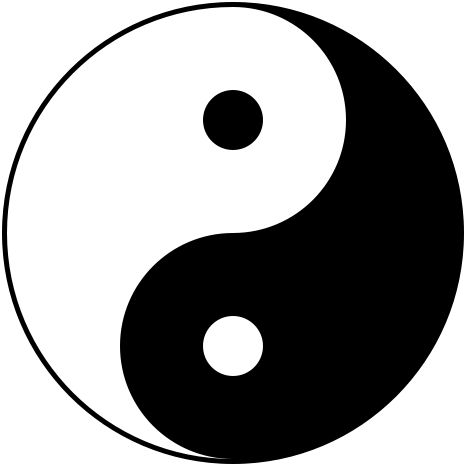
Basically it means that
“The complementary, interconnected, interdependent aspect of the same subject, or phenomenon.”
Basic concepts such as:
- Yin-Yang should be in a balance (equilibrium), means equal to each other
- Yin-Yang are depend on each other
- Yin-Yang can create each other (Yin creates Yang, Yang creates Yin, once Yin-Yang separate, this subject wouldn’t be able to exist)
- Yin-Yang are opposite of each other (can be absolutely, or relatively)
and examples of opposition are:
- Bright and Dark
- Heat(hot) and Cold
- High and Low
- Up and Down
- Moving and Stationary
- Surface and Internal
- Outside and Inside
- Male and Female
- Fire and Water
And from the basic concepts we can come up with more complicated concepts such as:
- Sky and Earth (sky is relatively high above, actively changing, earth is laying low, and relatively stationary)
- Sun and Moon (Sun is giving heat and light, moon is in the dark and do not bring heat)
- Day and Night (Day is bright, things are more active; night is dark, more things are in rest)
- Summer and Winter (Summer is hot, things grow; winter is cold, things to be stored)
- Human Chest and Human Back (front and back)
Basically Yin-Yang is grouping the similar pheonomen into big groups, and according to the groups, we find the ways to deal with them.
Although there are other concepts in Chinese Medicine, such as “Qi”, “five elements”, “blood”, “six evil energy”, but I believe the “Yin-Yang” is the easiest to understand.
A person who is health can be represent by the Yin-Yang balance as:
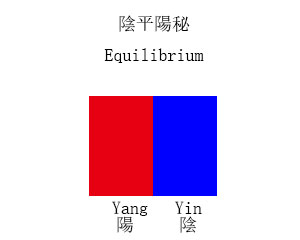
When a person’s Yin-Yang is balanced, then this person is healthy.
If any of the Yin or Yang are not balanced, then this person is in pathological condition.
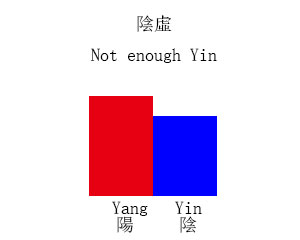
For people with insufficient of Yin, they may experience too much heat, constantly complain of been too hot, such as women experiencing menopausal symptoms; chronic inflammation commonly have this condition;
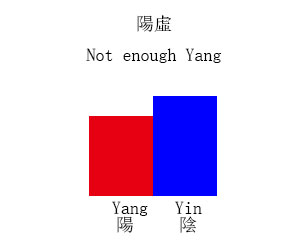
If someone has insufficent of Yang, then they will constantly complain of been cold all the time, and difficulty to warm themselves up; if ‘their heat’ can’t heat up the food in their stomach, then the food wouldn’t be able to be digested properly, causing loose stool, or diarrhea; people having insufficent of Yang may have difficulty to fight infections;
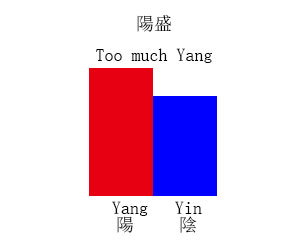
If someone has fever, their Yang is in excess, which need to be dealt with before the fire burn all the Yin energy;
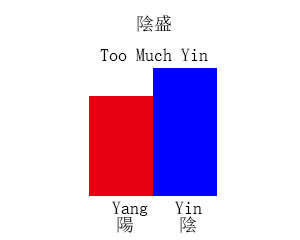
However, if someone complains of abdominal pain, pain gets worse in colder environment, and like drink warm, then they may be in a state of excessive of Yin, which warm the body up to get ride of the Yin is necessary.
This is a basic idea of Yin-Yang.
Well, what does the ‘Equilibrium’ stand in?
Remember, Chinese Medicine is based on ‘Qi’, and ‘Qi’ energy need to flow in the body:
- Qi can flow upward or downward
- Qi can flow inward or outward
What happens if the Qi is flowing in a wrongful mannar?
- Qi can flow upward or downward
- too much upward — too much energy to head–headaches, high blood pressure, coughing, short of breath
- too much downward — lack of energy, diarrhea, prolapse, low blood pressure, dizziness, heavy periods
- Qi can flow inward or outward
- too much inward — Qi won’t be able to flow, and stuck
- too much outward — excessive sweat
The above are just some ideas of what could go wrong. Human body can be way more complicated than that.
So there is the equilibrium in ‘Qi’
- it can’t be too cold, nor too hot
- it can’t go up too high, nor go down too low
- it can’t go in too much, nor go out too much
Ok, what can we do if the equilibrium is out of balance?
Acupuncture will help to stimulate the ‘Qi’ in the body, and this ‘Qi’ will automatically fix your problems by itself — if the acupuncture is done properly.
The Chinese Medical Herbal treatment, on the other hand, will look for the wrong balance, and bring the balance back with external force from food/herbs. Too much heat, cool it down; too much cold, warm it up; Qi goes too high, bring it down; Qi not rising, bring it up; bad energy come to the skin, sweat them off.
Wait a minute — if the herbs using external force, then could it do the job too much?
Yes, it can; for example, a person is in infection caused fever, using something cold could bring the heat down; but if use too much, could make the condition into an insufficient Yang state. Picture this:
becoming
There.
There are many times i hear from different sources, that eat this is good, eat that is good, then few years later some other sources said don’t eat this because it is not healthy and causing other problems. Well, if we consider the properties of the food we take, and our personal health properties, then this may not be a hazard food to us.
For example:
A 55 years old man who has low blood pressure, always cold and tire, is able to take ‘ginger’, as ginger will give him extra Yang energy he needs;
but his 47 years old wife who is going through menopausal may hate the idea of eating ‘ginger’ because this excess Yang energy will burn off the ‘not much left over’ Yin energy, making the Yang even more excessive
So, in a summary, when we take care of our health, we need to consider this:
Is this healthy FOR ME?
——————————————————
I hope after this first blog, you have some slight understanding of what Chinese Medicine is about.
Generally I do not read post on blogs, but I would like to say that this write-up very compelled me to try and do it! Your writing taste has been surprised me. Thanks, very nice article.|
Very informative post, i am regular reader of your site.
I noticed that your website is outranked by many other
blogs in google’s search results. You deserve to be in top-10.
I know what can help you, search in google for:
Kelustu’s tips outsource the work
Hello there! Would you mind if I share your blog with my zynga group?
There’s a lot of people that I think would really enjoy your content.
Please let me know. Cheers
Excellent beat ! I wish to apprentice whilst you
amend your website, how could i subscribe for a blog website?
The account aided me a applicable deal. I had been a little bit acquainted of this your broadcast provided shiny clear concept
For the reason that the admin of this web page is working, no hesitation very soon it will be
famous, due to its feature contents.
Hello Web Admin, I noticed that your On-Page SEO is is missing a few factors, for one you do not use all three H tags in your post, also I notice that you are not using bold or italics properly in your SEO optimization. On-Page SEO means more now than ever since the new Google update: Panda. No longer are backlinks and simply pinging or sending out a RSS feed the key to getting Google PageRank or Alexa Rankings, You now NEED On-Page SEO. So what is good On-Page SEO?First your keyword must appear in the title.Then it must appear in the URL.You have to optimize your keyword and make sure that it has a nice keyword density of 3-5% in your article with relevant LSI (Latent Semantic Indexing). Then you should spread all H1,H2,H3 tags in your article.Your Keyword should appear in your first paragraph and in the last sentence of the page. You should have relevant usage of Bold and italics of your keyword.There should be one internal link to a page on your blog and you should have one image with an alt tag that has your keyword….wait there’s even more Now what if i told you there was a simple WordPress plugin that does all the On-Page SEO, and automatically for you? That’s right AUTOMATICALLY, just watch this 4minute video for more information at. Seo Plugin
A person necessarily assist to make seriously articles I’d state.
This is the very first time I frequented your website
page and to this point? I surprised with the research you
made to create this actual put up extraordinary. Great
job!
That iss a really good tip particularly too those new to the blogosphere.
Simple but very accurate information… Appreciate your sharing this one.
A must read article!